Mina Harker
Location: London
ON Audio character voices were made with AI (ElevenLabs).
Narrated by Emma Taylor as Mina Harker
Where we are
London
Previous setting: London — Kingstead · Current setting: London
The cast · Chapter 17
Encountered so far

Mina Harker
Now married to Jonathan; keeps his journal safe after his illness.

Jonathan Harker
An English solicitor staying with the Count on business.

Lucy Westenra
Receives three proposals and accepts Arthur Holmwood.
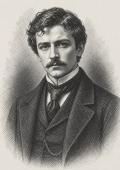
Dr. John Seward
Records his observations of asylum patient R. M. Renfield on a phonograph.
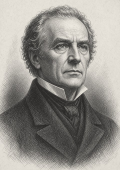
Abraham Van Helsing
Seward’s former teacher, a professor from Amsterdam called in to help Lucy.
29 September.
After I had tidied myself, I went down to Dr. Seward's study. At the door I paused a moment, for I thought I heard him talking with some one. As, however, he had pressed me to be quick, I knocked at the door, and on his calling out, "Come in," I entered.
To my intense surprise, there was no one with him. He was quite alone, and on the table opposite him was what I knew at once from the description to be a phonograph. I had never seen one, and was much interested.
"I hope I did not keep you waiting," I said; "but I stayed at the door as I heard you talking, and thought there was some one with you."
"Oh," he replied with a smile, "I was only entering my diary."
"Your diary?" I asked him in surprise.
"Yes," he answered. "I keep it in this." As he spoke he laid his hand on the phonograph. I felt quite excited over it, and blurted out:—
"Why, this beats even shorthand! May I hear it say something?"
"Certainly," he replied with alacrity, and stood up to put it in train for speaking. Then he paused, and a troubled look overspread his face.
"The fact is," he began awkwardly, "I only keep my diary in it; and as it is entirely—almost entirely—about my cases, it may be awkward—that is, I mean——" He stopped, and I tried to help him out of his embarrassment:—
"You helped to attend dear Lucy at the end. Let me hear how she died; for all that I know of her, I shall be very grateful. She was very, very dear to me."
To my surprise, he answered, with a horrorstruck look in his face:—
"Tell you of her death? Not for the wide world!"
"Why not?" I asked, for some grave, terrible feeling was coming over me. Again he paused, and I could see that he was trying to invent an excuse. At length he stammered out:—
"You see, I do not know how to pick out any particular part of the diary." Even while he was speaking an idea dawned upon him, and he said with unconscious simplicity, in a different voice, and with the naïvete of a child: "That's quite true, upon my honour. Honest Indian!" I could not but smile, at which he grimaced. "I gave myself away that time!" he said. "But do you know that, although I have kept the diary for months past, it never once struck me how I was going to find any particular part of it in case I wanted to look it up?" By this time my mind was made up that the diary of a doctor who attended Lucy might have something to add to the sum of our knowledge of that terrible Being, and I said boldly:—
"Then, Dr. Seward, you had better let me copy it out for you on my typewriter." He grew to a positively deathly pallor as he said:—
"No! no! no! For all the world, I wouldn't let you know that terrible story!"
Then it was terrible; my intuition was right! For a moment I thought, and as my eyes ranged the room, unconsciously looking for something or some opportunity to aid me, they lit on a great batch of typewriting on the table. His eyes caught the look in mine, and, without his thinking, followed their direction. As they saw the parcel he realised my meaning.
"You do not know me," I said. "When you have read those papers—my own diary and my husband's also, which I have typed—you will know me better. I have not faltered in giving every thought of my own heart in this cause; but, of course, you do not know me—yet; and I must not expect you to trust me so far."
He is certainly a man of noble nature; poor dear Lucy was right about him. He stood up and opened a large drawer, in which were arranged in order a number of hollow cylinders of metal covered with dark wax, and said:—
"You are quite right. I did not trust you because I did not know you. But I know you now; and let me say that I should have known you long ago. I know that Lucy told you of me; she told me of you too. May I make the only atonement in my power? Take the cylinders and hear them—the first half-dozen of them are personal to me, and they will not horrify you; then you will know me better. Dinner will by then be ready. In the meantime I shall read over some of these documents, and shall be better able to understand certain things." He carried the phonograph himself up to my sitting-room and adjusted it for me. Now I shall learn something pleasant, I am sure; for it will tell me the other side of a true love episode of which I know one side already. . . .