Jonathan Harker
Location: Whitby
ON Audio character voices were made with AI (ElevenLabs).
Narrated by Johnny Kid as Jonathan Harker
Where we are
Whitby
Previous setting: London · Current setting: Whitby
The cast · Chapter 17
Encountered so far

Jonathan Harker
An English solicitor staying with the Count on business.

Mina Harker
Now married to Jonathan; keeps his journal safe after his illness.

Count Dracula
Jonathan’s host; plans to purchase an English estate called Carfax.

Lucy Westenra
Receives three proposals and accepts Arthur Holmwood.

Dr. John Seward
Records his observations of asylum patient R. M. Renfield on a phonograph.

Arthur Holmwood
Lucy’s accepted suitor; a friend of Seward and Quincey Morris.
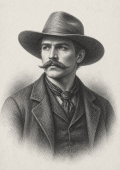
Quincey Morris
An old travelling companion of Arthur and Seward; invites them to a friendly gathering.

R. M. Renfield
A 59-year-old asylum patient whose behaviour interests Seward.

Abraham Van Helsing
Seward’s former teacher, a professor from Amsterdam called in to help Lucy.
29 September, in train to London.
When I received Mr. Billington's courteous message that he would give me any information in his power I thought it best to go down to Whitby and make, on the spot, such inquiries as I wanted. It was now my object to trace that horrid cargo of the Count's to its place in London. Later, we may be able to deal with it. Billington junior, a nice lad, met me at the station, and brought me to his father's house, where they had decided that I must stay the night. They are hospitable, with true Yorkshire hospitality: give a guest everything, and leave him free to do as he likes. They all knew that I was busy, and that my stay was short, and Mr. Billington had ready in his office all the papers concerning the consignment of boxes. It gave me almost a turn to see again one of the letters which I had seen on the Count's table before I knew of his diabolical plans. Everything had been carefully thought out, and done systematically and with precision. He seemed to have been prepared for every obstacle which might be placed by accident in the way of his intentions being carried out. To use an Americanism, he had "taken no chances," and the absolute accuracy with which his instructions were fulfilled, was simply the logical result of his care. I saw the invoice, and took note of it: "Fifty cases of common earth, to be used for experimental purposes." Also the copy of letter to Carter Paterson, and their reply; of both of these I got copies. This was all the information Mr. Billington could give me, so I went down to the port and saw the coastguards, the Customs officers and the harbour-master. They had all something to say of the strange entry of the ship, which is already taking its place in local tradition; but no one could add to the simple description "Fifty cases of common earth." I then saw the station-master, who kindly put me in communication with the men who had actually received the boxes. Their tally was exact with the list, and they had nothing to add except that the boxes were "main and mortal heavy," and that shifting them was dry work. One of them added that it was hard lines that there wasn't any gentleman "such-like as yourself, squire," to show some sort of appreciation of their efforts in a liquid form; another put in a rider that the thirst then generated was such that even the time which had elapsed had not completely allayed it. Needless to add, I took care before leaving to lift, for ever and adequately, this source of reproach.